

Living with a parrot is often compared to living with a permanent toddler—one equipped with a can opener on their face. When that “toddler” becomes hostile, the experience can be frightening and heartbreaking. Learning how to calm an aggressive parrot is not just about avoiding bites; it is about rebuilding a foundation of trust and understanding the silent language your bird is speaking. Over my years of documenting avian behavior and managing over 100 deep-dives into pet care at Pet Care Fables, I’ve learned that aggression is rarely “random.” By applying proven parrot aggression tips, you can transform a defensive bird into a confident companion.
Understanding the Root Causes of Parrot Aggression
Before you can fix the behavior, you must understand the “why.” Parrots are prey animals; their aggression is almost always a secondary response to fear, hormonal shifts, or environmental stress.
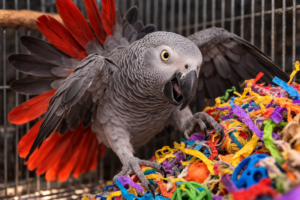
1. Hormonal Triggers (The “Spring Fever”)
During breeding season, even the sweetest cockatoo can become a lunging terror. Hormones increase territoriality. If your bird is guarding a specific corner of the cage or a “shreddy” toy, they likely view it as a nesting site.
2. Fear and Lack of Socialization
A parrot that wasn’t handled much as a chick or had a traumatic past will use its beak as a shield. If they lunge when you reach into the cage, they aren’t being “mean”—they are telling you they feel cornered.
3. Territoriality
The cage is your parrot’s castle. Many owners struggle with how to calm an aggressive parrot specifically when the bird is inside its enclosure. This is known as “cage aggression” and is often a result of the bird feeling their only safe space is being invaded.
Step-by-Step Guide: How to Calm an Aggressive Parrot
Phase 1: The “No-Reaction” Protocol
The biggest mistake owners make is screaming or pulling away dramatically when bitten. To a parrot, a loud “Ouch!” or a dramatic hand wave is “dramatic reinforcement.” They think, “Hey, when I bite, the human makes a funny noise and moves! Let’s do that again.”
-
Actionable Tip: If bitten, remain as calm as possible. Gently set the bird down and walk away for 2 minutes. This “time out” signals that aggression ends the social interaction.
Phase 2: Identifying Body Language
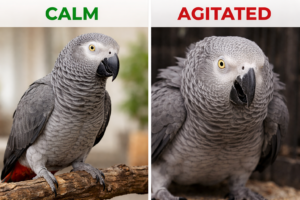
You can usually stop a bite before it happens if you watch for these signs:
-
Pinning Eyes: The pupils rapidly dilate and contract.
-
Fanning Tails: A sign of high arousal or agitation.
-
Fluffed Feathers on the Nape: Indicates the bird is “ready for battle.”
-
Beak Clicking: A clear warning to “back off.”
Phase 3: Targeted Training (The Bridge to Trust)
One of the most effective parrot aggression tips is Target Training. Using a chopstick (the target) and a clicker, you teach the bird to touch the stick for a treat. This allows you to move the bird around the cage or onto a perch without using your hands, reducing the “danger zone” for bites.
The “A-B-C” of Behavioral Analysis
To truly master how to calm an aggressive parrot, you must become a detective of the “A-B-C” model: Antecedent, Behavior, and Consequence. Most owners focus only on the Behavior (the bite), but the secret lies in the Antecedent (what happened right before).
-
Antecedent: You reached into the cage while the parrot was eating.
-
Behavior: The parrot lunged and bit your finger.
-
Consequence: You yelped and pulled your hand away, leaving the parrot alone.
In this scenario, the parrot learned that biting successfully “removed” the intruder from their dining space. To change this, you change the Antecedent. Instead of reaching in while they eat, wait until they move to a high perch, or “pay” for entry by dropping a high-value treat into a side dish before moving your hand. By shifting the environment, you provide parrot aggression tips that prevent the conflict before it starts. This proactive approach builds trustworthiness, as the bird begins to see your hand not as a threat, but as a harbinger of treats.
Advanced Parrot Aggression Tips: Environmental Changes
Sometimes, the secret to how to calm an aggressive parrot lies in their surroundings rather than their training.
Sleep Deprivation
Parrots need 10–12 hours of total darkness and quiet. A bird that only gets 6 hours of sleep is a “cranky” bird. Ensure their cage is covered or in a separate room where they won’t be disturbed by the TV or lights.

Diet and Sugar Rushes
High-energy diets full of sunflower seeds and sugar-laden fruits can lead to “behavioral spikes.” Transitioning your bird to a high-quality pellet-based diet supplemented with fresh vegetables (like broccoli, kale, and peppers) can stabilize their mood. According to the Association of Avian Veterinarians, a balanced diet is the cornerstone of avian mental health.
The Power of “Stationing”
Teach your parrot that they have a “station”—a specific perch outside the cage where good things happen. When you enter the room, offer a treat only when they are on their station. This moves the focus from “guarding the door” to “earning a reward.”
The Role of Foraging and Mental Enrichment
An idle beak is a biting beak. In the wild, parrots spend roughly 70% of their waking hours foraging for food. In a cage, food is served in a bowl, leaving them with 10 free hours and a massive amount of pent-up energy. This energy often manifests as “displacement aggression.”
If you are struggling with how to calm an aggressive parrot, look at their toy chest. Are the toys just hanging there? Or do they require work?
-
Shredding Toys: Use bird-safe balsa wood, yucca, or cardboard. Destroying things is a natural outlet for aggression.
-
Foraging Puzzles: Hide their daily pellets inside crumpled paper or specialized acrylic drawers.
-
The “Toy Rotation” Rule: Change the layout of the cage every two weeks. This prevents the bird from becoming overly “territorial” over a specific spot, as the environment remains dynamic.
Common Challenges and Actionable Solutions
Handling “The One-Person Bird” Syndrome
A frequent hurdle in how to calm an aggressive parrot is when the bird “bonds” to one family member and attacks everyone else. This is often a hormonal “mate-guarding” behavior. To solve this, the “favored” person must temporarily step back.
-
The Neutral Room Strategy: Take the parrot to a room they aren’t familiar with. In a neutral space, they are less likely to guard territory and more likely to look to a human—any human—for security.
-
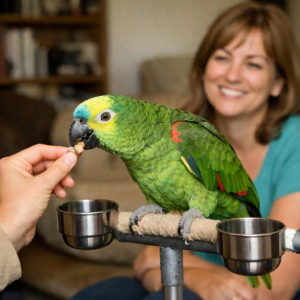
The “Good Cop” Routine: Only the “disliked” person should give the most prized treats (like sunflower seeds or almonds). The “favored” person should only provide basic care.
-
Hands-Off Interaction: Have the family member the parrot dislikes sit near the cage and read a book aloud. This builds Authoritativeness through passive bonding, showing the bird that this person is a safe, non-threatening member of the flock.
Case Study: “Mango” the Sun Conure
Mango was a rescue who would draw blood every time his owner tried to change his water. By implementing a strict 12-hour sleep schedule and using a “bridge” (a handheld perch) instead of a hand for the first month, Mango learned that hands weren’t threats. Today, Mango steps up reliably because his owner learned to respect his “no” when his eyes started pinning.
Deep Dive: Behavioral Health
When researching how to calm an aggressive parrot, it is vital to look into positive reinforcement training (PRT). Unlike older “dominance” models (like the “laddering” technique, which can actually increase aggression), PRT focuses on rewarding what the bird does right.
Why Dominance Doesn’t Work
You cannot “dominate” a parrot. They do not have a “pack” hierarchy like dogs. They have “flock” dynamics based on cooperation. If you try to force a parrot into submission, you will destroy the bond permanently.
Frequently Asked Questions (FAQs)
How long does it take to calm an aggressive parrot?
It varies. For a hormonal bird, it may take 4–6 weeks for the season to pass. For a traumatized bird, it can take 6 months to a year of consistent, daily work. Patience is your greatest tool.
Should I wear gloves to handle a biting parrot?
No. Gloves are terrifying to birds and often make aggression worse. They also prevent you from feeling the bird’s grip, which can lead to accidental injury to the parrot. Use a perch if you are afraid of being bitten.
Does wing clipping help with aggression?
This is controversial. While it prevents a bird from “dive-bombing,” it can increase “ground-based” aggression because the bird feels they cannot escape and must fight. Most modern behaviorists recommend keeping the bird flighted but focusing on training.
Conclusion: Rebuilding the Flock Bond
Learning how to calm an aggressive parrot its a journey of empathy. By utilizing these parrot aggression tips—from adjusting sleep cycles to mastering target training—you aren’t just “fixing” a pet; you are becoming a better communicator. Remember that your bird is communicating their needs in the only way they know how.
Consistency is the key to trust. Start today by simply sitting near your parrot’s cage and reading aloud, showing them that your presence is peaceful and non-threatening.
Ready to dive deeper into avian care? Check out our latest guides on bird nutrition and enrichment at Pet Care Fables to ensure your feathered friend lives their best, happiest life.
