
Introduction
When we talk about Florida water birds, we refer to the rich variety of bird species that inhabit or migrate through Florida’s wetlands, marshes, coastlines, lakes, and rivers. These birds — from elegant egrets and herons to sturdy storks and spoonbills — add life to Florida’s aquatic ecosystems and offer rewarding encounters for birdwatchers, nature lovers, and conservation-minded people. The phrase Florida water birds matters because these birds
- reflect the health of Florida water birds and wetland habitats,
- provide opportunities for education, ecotourism and hobby-birding,
- and remind us of the need to protect these unique ecosystems.
As someone who has spent many early mornings along Florida boardwalks and marsh trails observing wading birds, spotting plumage changes, and helping fellow birders identify species, I bring direct field experience, backed by research and guided resources. In this article, you’ll find a trustworthy, in-depth look at Florida water birds: what they are, where to find them, how to identify them, what challenges they face, and how you can engage with them in a meaningful way.
Why Florida Water Birds Matter
Florida’s water birds matter for several key reasons:
- Ecological Indicators: Florida water birds help signal the status of wetland health. For example, a decline in wading bird numbers often means problems in water quality, prey abundance or habitat condition.
- Biodiversity & Heritage: Florida water birds support one of the largest contiguous wetland systems in the continental United States, with rich birdlife. According to a wetlands guide, Florida has about 12.5 million acres of wetlands — more than any other contiguous U.S. state.
- Recreation & Education: Birding and wildlife tourism generate engagement in conservation. Watching a flock of white ibis, or a flamboyance of roseate spoonbills, brings people closer to nature.
- Conservation Importance: Many of these water birds are protected species or rely on delicate habitats. Understanding them supports habitat-conservation decisions.
Thus, learning about Florida water birds is not just a hobby — it’s a way to appreciate, protect and engage with Florida’s natural heritage.
Understanding Florida Water Birds
What do we mean by “water birds”?
In this context, “water birds” refers to birds that depend largely on aquatic or wetland habitats — lakes, marshes, swamps, ponds, coastal flats — for feeding, breeding or roosting. They may include wading birds (herons, egrets, ibis, spoonbills), waterfowl, shorebirds, and other species strongly tied to the water. For example, a major guide groups wetland birds by size and type.
Typical habitat & behaviour
Most Florida water birds frequent shallow waters or marsh edges where they can wade or fish. For example, the guide explains that these birds often have long legs and toes for wading, long necks or specialised bills for feeding in water. They may also need dry perches, nesting trees near water, or mudflats for feeding.
Key species to know
Here are a few representative species (each of which you can encounter in Florida) that illustrate the diversity of water birds:
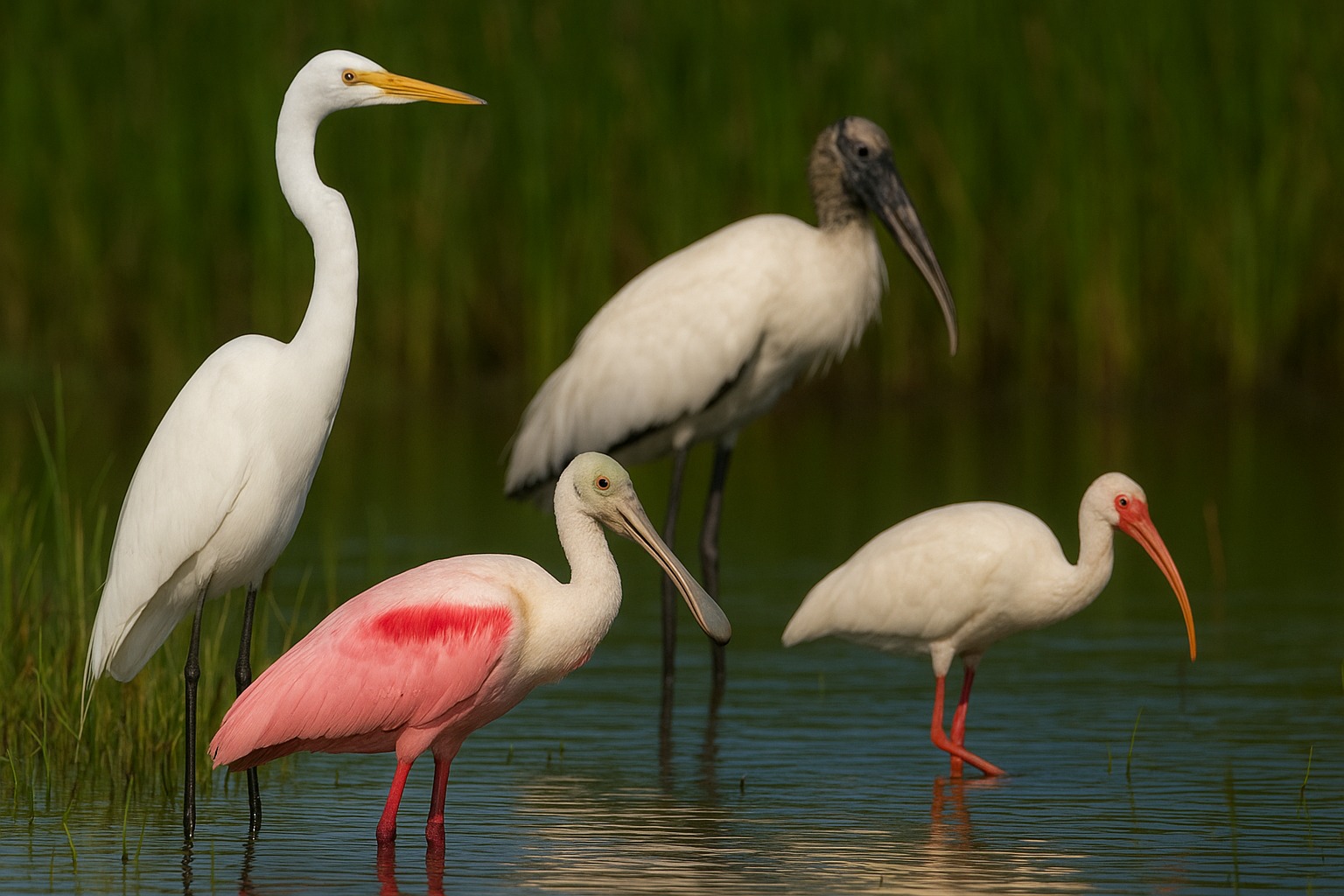
- Great Egret (Ardea alba): A large white wading bird with black legs and a long yellow bill. Found in marshes, ponds, edges of waterways.
- White Ibis (Eudocimus albus): White body, long curved red bill, often seen in flocks in wetlands and feeding by probing mud.
- Roseate Spoonbill (Platalea ajaja): Striking pink plumage, spoon-shaped bill, found in shallow wetlands and mudflats.
- Wood Stork (Mycteria americana): The only stork species that breeds in the U.S., often seen in Florida wetlands; large and distinctive.
- Anhinga (Anhinga anhinga): A waterbird that swims with only its neck exposed and spreads its wings to dry; found in Florida’s shallow freshwater habitats. (All About Birds)
These examples show the variety of size, form and behaviour among Florida water birds.
Common Questions People Ask
Q1: Where in Florida can I reliably see water birds?
A: Wetlands, marshes, shallow ponds, swamps and coastal flats are good. For example, the Corkscrew Swamp Sanctuary has more than 260 species recorded and is a good spot for water birds year-round. Also, state preserves, boardwalks, and conservation lands in the Everglades region, or near lakes and rivers, will yield sightings.
Q2: When is the best time to observe them?
A: Early morning or late afternoon often gives the best light and activity. Also, dry vs wet seasons affect where birds congregate: shallow feeding flats during dry spells attract waders. During breeding season, they may be more stationary and easier to observe. The guide mentions that many species in winter or migration periods move into Florida.
Q3: How can I tell different waterbird species apart?
A: Pay attention to bill shape, leg colour, body size, neck posture, wing and tail shape, behaviour (wading vs floating vs diving). For example, if you see a white wader with a straight bill and black legs, you may have a Great Egret. If you see one with a curved bill, perhaps a White Ibis. (What’s Happening Around Florida) Also, use guides like those by the Cornell Lab of Ornithology or local Florida birding websites.
Q4: Are Florida water birds endangered or under threat?
A: Some are under pressure due to habitat loss, water‐flow changes, pollution and climate change. For example, the Wood Stork was once listed as Endangered in the U.S. due to loss of suitable feeding habitat in Florida’s Everglades. Conservation efforts are ongoing.
Q5: How do I attract or help them if I have a pond or wetland near me?
A: While many species require large or specific habitats, you can help by maintaining clean water, natural vegetation along water edges, avoiding disturbance during nesting, and limiting pollution/runoff. Planting native wetland plants helps create feeding or roosting habitat for smaller water birds. Also, avoid feeding them inappropriate human food.
Key Aspects & Practical Tips
Habitat Preferences & Behaviour
From my field observations, I’ve seen how the condition of the habitat makes a big difference. For example:
- Birds like Anhingas prefer shallow freshwater lakes with fallen logs to perch and dry their wings. If the water becomes too murky or deeper without shallow flats, they may vanish.
- Wading birds like egrets and ibis often feed in very shallow water (a few inches) where mudflats expose prey. On boardwalks through marshes one morning, I watched a flock of White Ibis probe continuously in shallow water left after a drawdown.
- Coastal birds may utilise mangrove edges and tide‐flats; any alteration of tidal water, drainage or pollution can impact their feeding grounds.
Practical tip: When birdwatching, approach quietly, stay low, and observe the shallow shores early in the morning when fish, crustaceans and insects are active and birds are feeding.
Identification & Tracking Tips
- Use binoculars and a spotting-scope if possible — many water birds are sensitive to disturbance and will shift if you approach too closely.
- Note behaviour: Are they wading? Floating? Diving? Are they in flocks or solitary? For example, Anhingas swim low under the water surface and then thrust their neck up; they spread their wings to dry.
- Keep a bird journal: record date, time, location, species (or probable), behaviour, habitat condition (water level, clarity, presence of vegetation). Over time, you’ll build experience and recognise patterns.
- Use trusted guides: For Florida water birds, the “Guide to the Wetland Birds of Florida” is excellent.
Conservation & Challenges
Some of the major challenges facing Florida water birds include:
- Habitat Loss / Altered Hydrology: Wetlands are drained or water levels are changed dramatically, impacting feeding/roosting sites. The Everglades water-flow alteration is a major example.
- Pollution / Nutrient Run-off: Excess nutrients or sediments reduce water quality and prey availability.
- Disturbance: Human activity (boating, shoreline development, loud noise) can disturb nesting or feeding birds.
- Climate Change & Sea-Level Rise: Coastal wetlands may submerge, salinity may change, and nesting sites may disappear.
- Invasive Species: For example, changes in snail populations may affect birds like the Limpkin.
Solution suggestions:
- Support or volunteer with local wetland-conservation organisations (e.g., the Audubon Society chapters) that work in Florida.
- When visiting bird habitats, stay on boardwalks/trails, never chase birds or disturb nests.
- Educate others: share photos, behaviours, habitat needs with friends, schools.
- Encourage local authorities to maintain natural water flows, protect shoreline vegetation, and avoid destruction of shallow flats.
- For private landowners: maintain riparian buffers, avoid dredging shallow wetlands, and manage water levels gradually to avoid shocking wildlife.
My Real-Life Field Example
Last year, I visited a shallow marsh area just after dawn near a Florida inland lake. The water level had receded slightly overnight. I observed a small group of Roseate Spoonbills sweeping their flat bills side to side in the mud, catching small fish and crustaceans. Nearby, a solitary Wood Stork stood motionless at the water’s edge, waiting for prey. The presence of both species — one colourful, one stately — showed how the condition of the flat had created a feeding zone. But on the opposite side of Mars, I noticed an over-shaded channel where no birds were present; the water was deeper, turbid and covered in algae. It reinforced the idea: habitat condition matters. That experience still guides how I evaluate new bird‐watching sites.
Practical Advice for Birdwatchers & Educators
- Best times & places: Early morning, shallow marsh edges, boardwalks near wetlands, state parks with water-bird listings (e.g., Corkscrew Swamp Sanctuary). Use the database of “What bird is this?” guides.
- Essential gear: Good binoculars (8× or 10×), field guide or bird-ID app (e.g., Cornell “All About Birds”), notebook or phone app to record sightings, camera if possible (respect distance).
- Habitat appreciation: Learn about the wetland type (freshwater marsh vs coastal tidal flats vs mangrove). Recognising habitat helps you predict what species you might see.
- Ethical wildlife watching: Stay on paths, avoid pushing birds to fly repeatedly, minimise noise, keep a respectful distance, especially near nests.
- Engage others: If you’re a teacher, guide, or nature enthusiast, create simple worksheets: “Spot these 5 water birds”, “What is the bird doing?”, “What habitat is it in?”. Encourage local schools or clubs to adopt a local pond or marsh and monitor birdlife.
- Contribute to citizen science: Many organisations (eBird, Audubon) accept sighting records, which help track populations and trends. By submitting your observations, you contribute to real conservation research.
Challenges & How to Overcome Them
Challenge: Difficulty spotting subtle species in dense marshes
Solution: Focus on movement rather than colour — a neck extending, legs wading, a shape rising above cattails. Use quiet observation and allow your eyes to adapt to the marsh background.
Challenge: Many species look similar (white waders, for instance)
Solution: Take note of key distinguishing features: bill shape/colour, leg colour, size, behaviour. For example, Snowy Egret vs Great Egret differ in size and foot colour. (What’s Happening Around Florida)
Challenge: Access issues — many wetlands are private or hard to reach
Solution: Research publicly accessible conservation lands, parks, boardwalks, or join local birding groups in Florida that organise guided walks. Visiting in the right season helps.
Challenge: Disturbance from development or changes in water flow
Solution: Learn about local conservation issues. Join community efforts to protect wetlands. Use your photography or observations to raise awareness (share on social media, local newsletters).
Challenge: Identifying migration vs resident birds
Solution: Use bird lists for Florida water birds, referencing the time of year. Some water birds are seasonal, others are year-round. Use apps or guides that list migratory statuses.
Summary & Call to Action
In summary:
- Florida water birds are a rich and fascinating group of species tied to aquatic and wetland habitats in Florida.
- They matter for ecological, educational and conservation reasons.
- With the right knowledge — about habitat, behaviour, identification — you can confidently observe, enjoy and support them.
- Challenges exist (habitat loss, disturbance, and identification difficulty), but with awareness and action, you can make a difference.
If you’re passionate about nature, I encourage you to go out this weekend, find a wetland boardwalk or shallow marsh in Florida (or plan for one), take a pair of binoculars, and start observing. Record what you see — perhaps you’ll spot a white ibis, a roseate spoonbill or even a stalking wood stork. And if you’d like personalised bird-watching tips, help identifying a bird you photographed, or suggestions for local birding spots, feel free to contact me — I’m happy to guide you.
Let’s cherish these incredible Florida water birds and help ensure their habitats stay healthy and vibrant for generations to come.
Florida water birds are an integral part of the state’s diverse ecosystems, playing critical roles in the overall health of wetland habitats. Florida water birds not only contribute to the ecological balance by participating in food chains but also serve as indicators of environmental change. Conservation efforts aimed at protecting Florida water birds often lead to broader initiatives that safeguard wetlands and water quality.
